

Structured cabling is the longest-lived component in your IT estate. Servers get replaced every five years, switches every seven, but the cable in the walls will likely outlast two building managers. Every device you buy for the next fifteen years inherits the quality of a decision you are making now, and you will not be able to inspect that decision once the ceiling tiles go back.
That asymmetry is the whole problem. At the point of choosing a contractor, almost everything you are told is unverifiable. So the only sensible strategy is to ask about the things that produce physical evidence you can hold at handover.
1. Will you give me certified test results for every link?
This is the single most useful question, and the answer separates professionals from the rest immediately.
A properly installed link is tested with a calibrated field tester against the parameters in the relevant standard: insertion loss, return loss, near-end crosstalk, power-sum crosstalk, attenuation-to-crosstalk ratio, propagation delay and delay skew. The tester produces a result file per link.
What you want: the complete exported result set, one record per port, with the tester model and its calibration date.
What you do not want: a signed sheet saying “all links tested and passed”. That is not a test result, it is an assertion about test results.
Ask which tester will be used and when it was last calibrated. An uncalibrated tester produces confident numbers that mean nothing.
2. What documentation will I receive?
A cabling system you cannot navigate is a cabling system you will eventually rip out. Documentation is what keeps it maintainable after the people who built it have gone.
At minimum, insist on:
- Floor plans marking every outlet with its identifier
- A cable schedule identifying both ends of every run
- Rack elevations showing patch panel layout and port assignment
- The labelling scheme, documented, so future additions can follow it
ANSI/TIA-606 exists specifically to standardise this. A contractor who has not heard of it is telling you something.
3. Is the labelling applied at both ends?
It sounds trivial. It is the difference between a five-minute fault and a two-hour one.
Single-ended labelling is common because it is faster, and it is close to useless. Tracing a run means someone at the patch panel and someone with a toner, walking the building. Both ends, matching the documentation, is the standard to hold.
4. Does the warranty cover installation, or only materials?
This is where warranty claims quietly evaporate.
A materials warranty comes from the cable and connector manufacturer. It costs the contractor nothing to pass on, and it will not help you when the fault is a badly terminated connector or a cable pulled past its bend radius, which is what actually goes wrong.
An installation warranty means the contractor is liable for their own workmanship. Ask for the term, ask what it excludes, and ask for it in writing. A contractor confident in their work will give you 25 years without flinching. One who is not will start explaining why warranties are complicated.
5. Who is actually doing the work?
Cabling is frequently subcontracted, sometimes several layers deep. You may be buying a brand and receiving a crew nobody has met.
Ask directly: are the installers employed by you, and are they manufacturer-trained? Manufacturer certification matters here because extended warranties are usually conditional on installation by trained personnel, so an uncertified crew can void the warranty you are paying for.
6. How will you handle the parts of my building you cannot see yet?
Every refurbishment has surprises: a route that is not where the drawings say, asbestos, a structural member in the way, a riser already full.
The answer you want describes a process: how variations are identified, priced and approved before work continues. The answer you do not want is confident reassurance that there will not be any surprises, which means you will discover them as invoices.
7. Cat6A or fibre?
Not a trick question, and the right answer is usually “both, in different places”.
| Cat6A copper | Fibre | |
|---|---|---|
| Use for | Horizontal runs to desks, access points, cameras | Backbone between floors and buildings |
| Distance | Up to 100 m | Hundreds of metres to kilometres |
| Power over Ethernet | Yes: powers APs, cameras, phones | No |
| Electrical isolation | No | Yes, matters between buildings |
| Bandwidth headroom | 10 Gbps | Far higher, and upgradable by changing optics |
The practical rule: copper to the device, fibre between the distributors. Because fibre cannot carry PoE, a “fibre everywhere” proposal for an office with wireless access points and IP cameras has not been thought through.
Where a contractor proposes Cat6 rather than Cat6A to save money, ask them to put in writing that it meets your bandwidth requirement for the building’s expected life. The marginal cost difference is small against the cost of re-cabling.
8. Will you certify what is already there?
If you have inherited cabling of unknown quality, this is the cheapest useful thing you can buy.
A certification survey tests the existing installation and tells you what passes, what fails, and what it would cost to remediate, before you commit to a full replacement. It is common to discover that most of an installation is sound and a minority of links are the cause of recurring faults.
A contractor who offers this is confident around other people’s work. A contractor who insists everything must be replaced may be right, but should be asked to prove it with test results.
A short checklist to take into the meeting
- Certified per-port test results, exported, with tester calibration date
- As-built floor plans, cable schedules with both ends identified, rack elevations
- Labelling at both ends, following a documented scheme
- Warranty covering installation workmanship, term stated in writing
- Installers directly employed and manufacturer-trained
- A written variation process for unforeseen building conditions
- Copper-to-device and fibre-backbone design, justified against your bandwidth horizon
- Willingness to test and remediate existing cabling rather than only replace it
If a contractor answers all eight without hedging, the quality of their work is very likely to match. Those answers are hard to give convincingly if the underlying practice is not there.
- Tested
- every link, not a sample
- Labelled
- both ends, to a documented scheme
- Warranty
- installation workmanship, not materials alone
- The tell
- a contractor who hedges on any of these
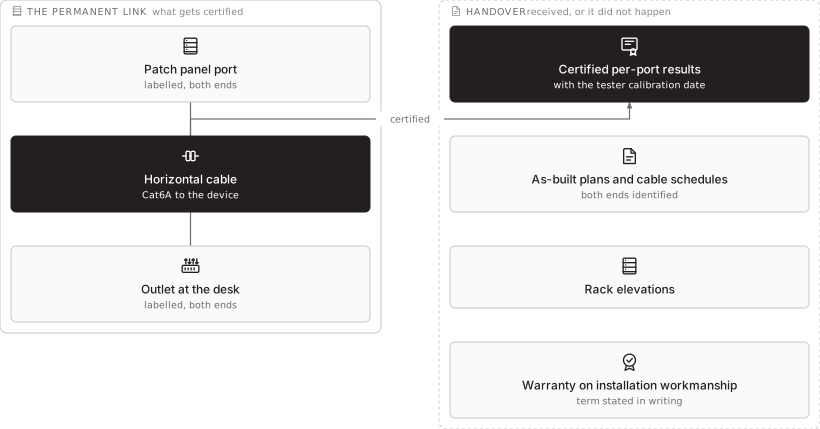
This diagram as text
- The permanent link what gets certified
- Patch panel port — labelled, both ends
- Horizontal cable — Cat6A to the device
- Outlet at the desk — labelled, both ends
- Handover received, or it did not happen
- Certified per-port results — with the tester calibration date
- As-built plans and cable schedules — both ends identified
- Rack elevations
- Warranty on installation workmanship — term stated in writing
Relationships
- Patch panel port → Horizontal cable
- Horizontal cable → Outlet at the desk
- Horizontal cable → Certified per-port results — certified
How STP answers these
We publish our own answers because it would be strange to write this and not.
Every STP installation is delivered with certified test results per link, as-built documentation including cable schedules identifying both ends, labelling at both ends, and a 25-year warranty covering materials and installation. Installers are directly employed and manufacturer-trained. We also test and certify systems installed by other companies, and quote remediation separately so you can see exactly what you have inherited.
Read more about our structured cabling service, or talk to us about a specific building.