

Schema migrations cause more avoidable outages than almost anything else in a deployment pipeline, and they do it in a characteristic way: the change is tested, it is small, it passes in staging in under a second, and in production it holds a lock on a table with forty million rows while every request behind it queues.
The pattern that removes this is old and well documented. What is usually missing is the discipline to apply it to changes that look too small to need it.
Expand, migrate, contract
The idea is that the schema and the code change in separate deployments, and that between them both the old and the new shape work.
- Reversible
- at every step, without data loss
- Lock held
- briefly, and never while rewriting
- Gate on
- replication lag, not primary throughput
This diagram as text
- 1 · Expand — add the new column: nullable, no default — brief lock, no rewrite
- 2 · Write both — code writes old and new, reads old
- 3 · Backfill — batches, with a pause, watching replication lag
- 4 · Contract — read the new column, then drop the old one
Relationships
- 1 · Expand → 2 · Write both — ships alone
- 2 · Write both → 3 · Backfill — ships alone
- 3 · Backfill → 4 · Contract — ships alone
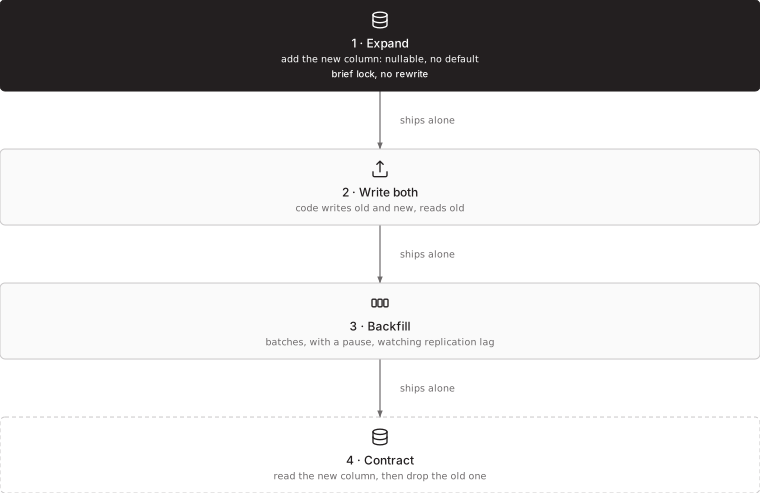
Expand. Add the new column as nullable with no default. On a modern PostgreSQL this is a metadata change and takes a brief lock. Do not add a constraint yet and do not add a default that has to be written to every row.
Write both. Deploy code that writes to both columns and still reads the old one. The application is now compatible with both shapes, which is what makes everything after this reversible.
Backfill. Copy the data in batches, each committing quickly, with a pause between them. Watch replication lag rather than primary throughput: the primary will usually keep up long after the replicas have fallen behind, and a replica that is minutes behind is a failover you cannot take.
Switch the read. Deploy code that reads the new column. Still writing both. This is the step you roll back if anything is wrong, and rolling it back costs nothing because both columns are current.
Contract. Stop writing the old column, then drop it, once no deployed version references it.
Five deployments for one rename. It feels absurd until the first time a migration holds a lock for forty minutes.
The locks worth knowing
The specifics vary by engine and version, and the shape of the problem does not. These are the operations that routinely surprise people:
| Change | Why it hurts | Safer form |
|---|---|---|
| Add column with a volatile default | Rewrites every row under a strong lock | Add nullable, backfill in batches, then set the default |
| Change a column type | Full rewrite, lock held throughout | New column, dual write, backfill, swap |
| Add a foreign key or check constraint | Validates every existing row while holding a lock | Add as not valid, then validate separately |
| Add an index | Blocks writes for the duration | Build concurrently |
| Rename a column | Instant in the database, breaks every deployed version at once | Expand and contract |
The last row is the one that catches careful teams. The database operation really is instant. The outage comes from the application, because the previous version is still running on half the instances and it is now querying a column that no longer exists.
Make it rehearsable
The reason migrations are dangerous is that they are tested against data that does not resemble production. A table with ten thousand rows in staging tells you the syntax is right and nothing about the lock.
Two things fix this, and they are the same two things that make ephemeral environments worth building:
- Production-shaped data in a lower environment, obfuscated inside the production boundary before it is exported. Same row counts, same distributions, same index bloat.
- The migration runs in the pipeline, against that data, on every pull request. A migration that takes four minutes in the rehearsal is a conversation before the release rather than an incident during it.
Things that are not optional
A timeout on the migration itself. Set a lock timeout and a statement timeout so a migration that cannot acquire its lock fails fast instead of queueing every request behind it. A failed migration is a deployment you retry. A queued one is an outage.
A plan for the backfill that is already running. Backfills get interrupted. The job has to be restartable from where it stopped, which means tracking progress somewhere durable rather than in a loop variable.
Knowing which version reads what. The contract step is only safe when no running instance references the old column. If you cannot answer that from deployment records, you are guessing.
How STP approaches this
We treat a migration as a sequence of independently reversible deployments rather than as one change, run it in the pipeline against obfuscated production-shaped data so the lock behaviour is known before the release, and gate the backfill on replication lag rather than on how fast the primary is coping. Where an estate has taken an outage for a migration, the rehearsal environment is usually the missing piece rather than the technique.
More on DevOps and platform automation and secure SDLC, or start a conversation.